
Does your brain have a kind of kill switch that operates when intuitively you think that swing faster / harder will get you more distance?
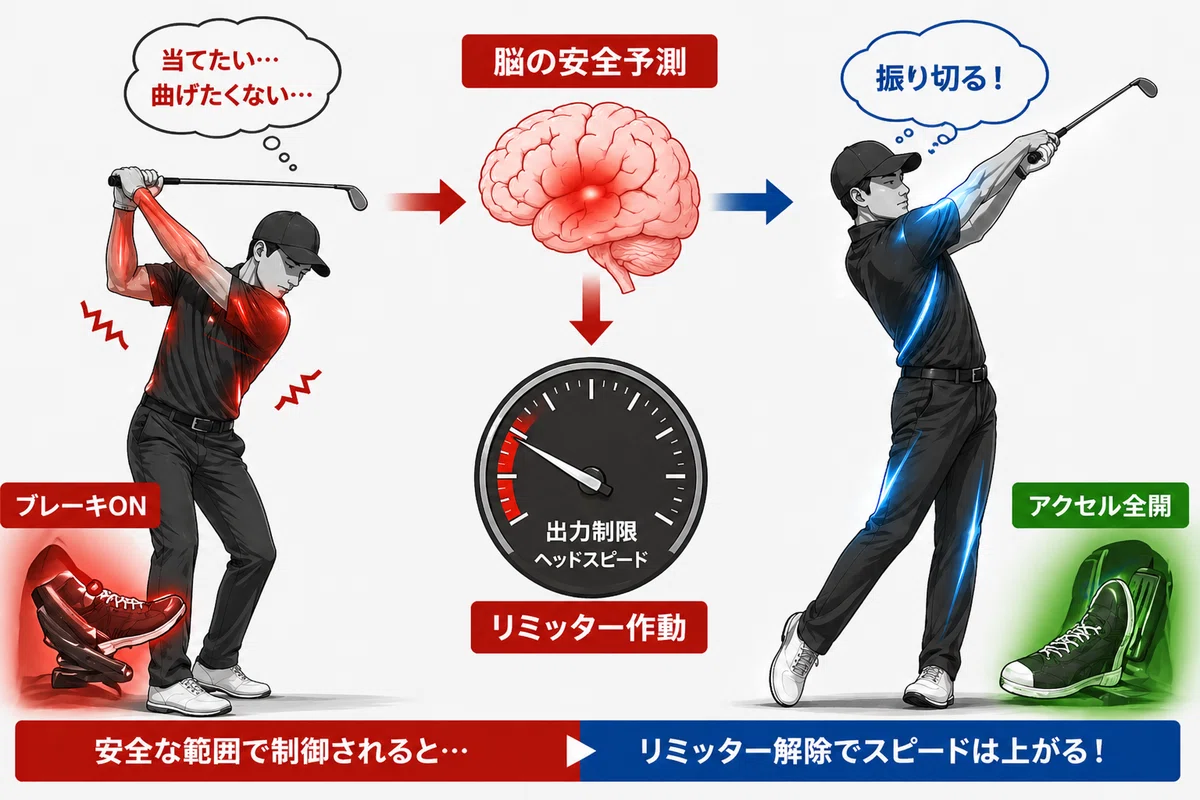
Yes, the neuromotor system effectively has a built-in "kill switch" that triggers when a golfer tries to swing with maximum conscious effort.
This phenomenon is driven by neuromotor inhibition and protective biological feedback mechanisms. Instead of generating more distance, swinging "too hard" floods the nervous system with tension, causing the brain to actively throttle performance.
The neuromotor system reacts to excessive, voluntary effort through specific physiological mechanisms:
1. Co-Contraction and Agonist-Antagonist Interference. When you consciously try to "smash" the ball, your brain triggers a massive survival response. Instead of activating muscles sequentially (the kinetic chain), it fires the agonist (accelerating) and antagonist (braking) muscles at the exact same time.
- The "Kill Switch" Effect: The muscles responsible for slowing down and protecting your joints stiffen prematurely. This creates internal friction, actively fighting your own speed and dramatically dropping your club head velocity.
2. The Golgi Tendon Organ (GTO) Reflex. The Golgi Tendon Organ is a sensory receptor located at the junction of muscles and tendons. It acts as a literal mechanical safety valve for the human body.
- The "Kill Switch" Effect: When you swing with violent, uncoordinated effort, the GTO senses a dangerous spike in muscle tension. To prevent you from tearing a tendon or dislocating a joint, it sends an emergency signal to the spinal cord to inhibit agonist muscle contraction. It forcibly shuts down your power mid-swing.
3. Destruction of the Kinematic Chain A powerful golf swing relies on proximal-to-distal sequencing: energy flows from the ground, to the hips, to the torso, through the arms, and finally into the club.
- The "Kill Switch" Effect: Voluntary effort usually manifests as "pulling" with the hands and tightening the shoulders. This over-excitation of the upper body disrupts the lower body's timing. Because the sequencing is broken, energy leaks out before impact, resulting in shorter, weaker drives.
4. Overriding "Automatic Motor Programs" Highly practiced motor skills are stored in subcortical structures of the brain (like the cerebellum and basal ganglia) so they can execute automatically at high speeds.
- The "Kill Switch" Effect: Trying too hard shifts control back to the prefrontal cortex (the thinking brain). The conscious mind cannot process the 1.09-second duration of a full swing in real-time. This conscious interference causes "paralysis by analysis," fragmenting a smooth athletic motion into rigid, mechanical jerks.
Comparison: "Swinging Hard" vs. "Swinging Fast"
To maximize distance, elite golfers don't focus on muscular force. Instead, they focus on rhythm, relaxation, and external targets, which bypasses the nervous system's built-in kill switch and allows the body to release its full athletic potential. ]If you are trying to fix an issue with overswinging, let me know:
- Do you struggle more with directional accuracy (slices/hooks) or poor contact (fat/thin shots) when swinging hard?
- Are you looking for mental triggers to slow down, or physical drills to build effortless speed?
I can provide specific adjustments to help you unlock a smoother, more powerful release.
Thank you and Best Regards
宜しくお願いします。
Tom Fielding
トムフィールディング ゴルフスクール
090 6709 1728