
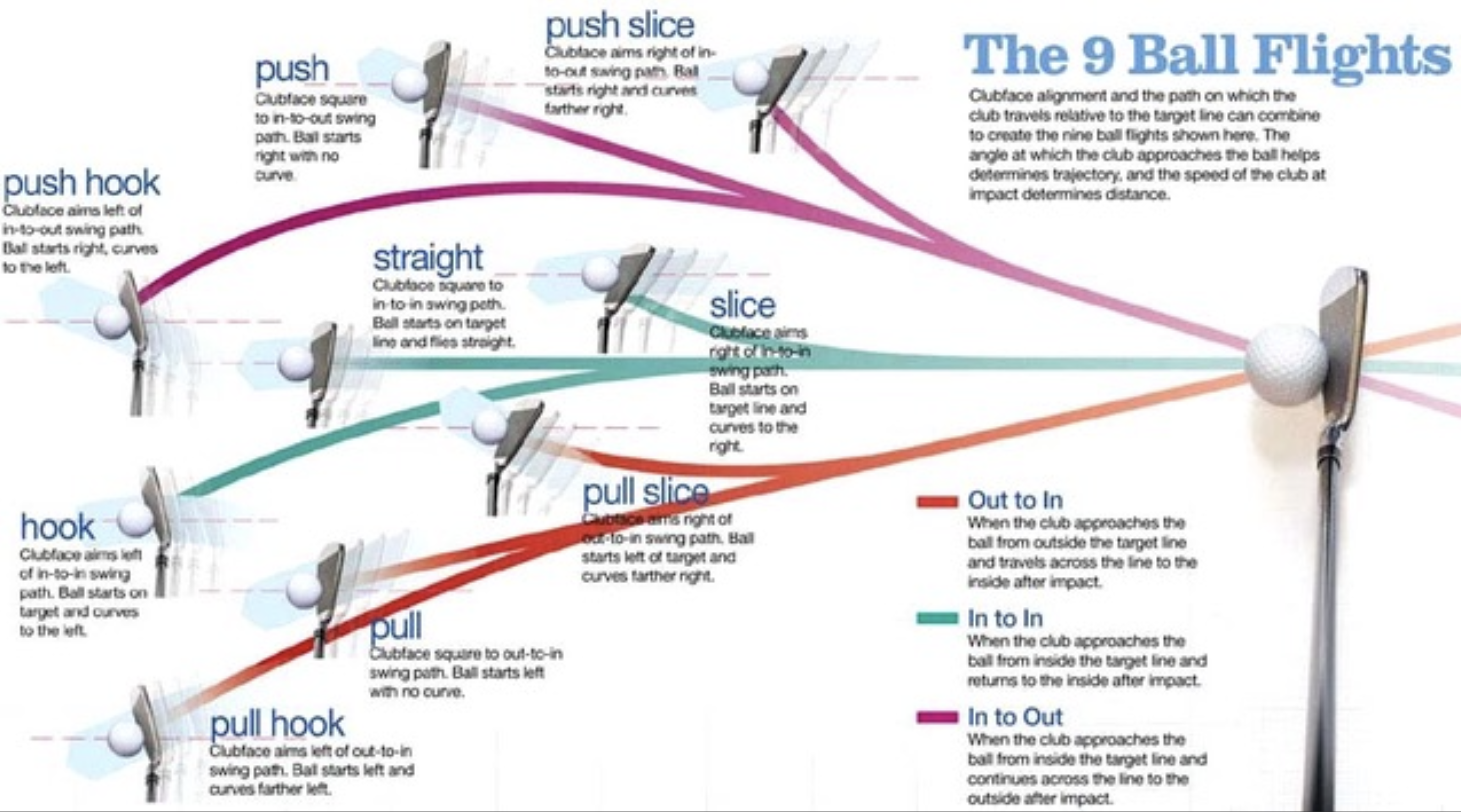
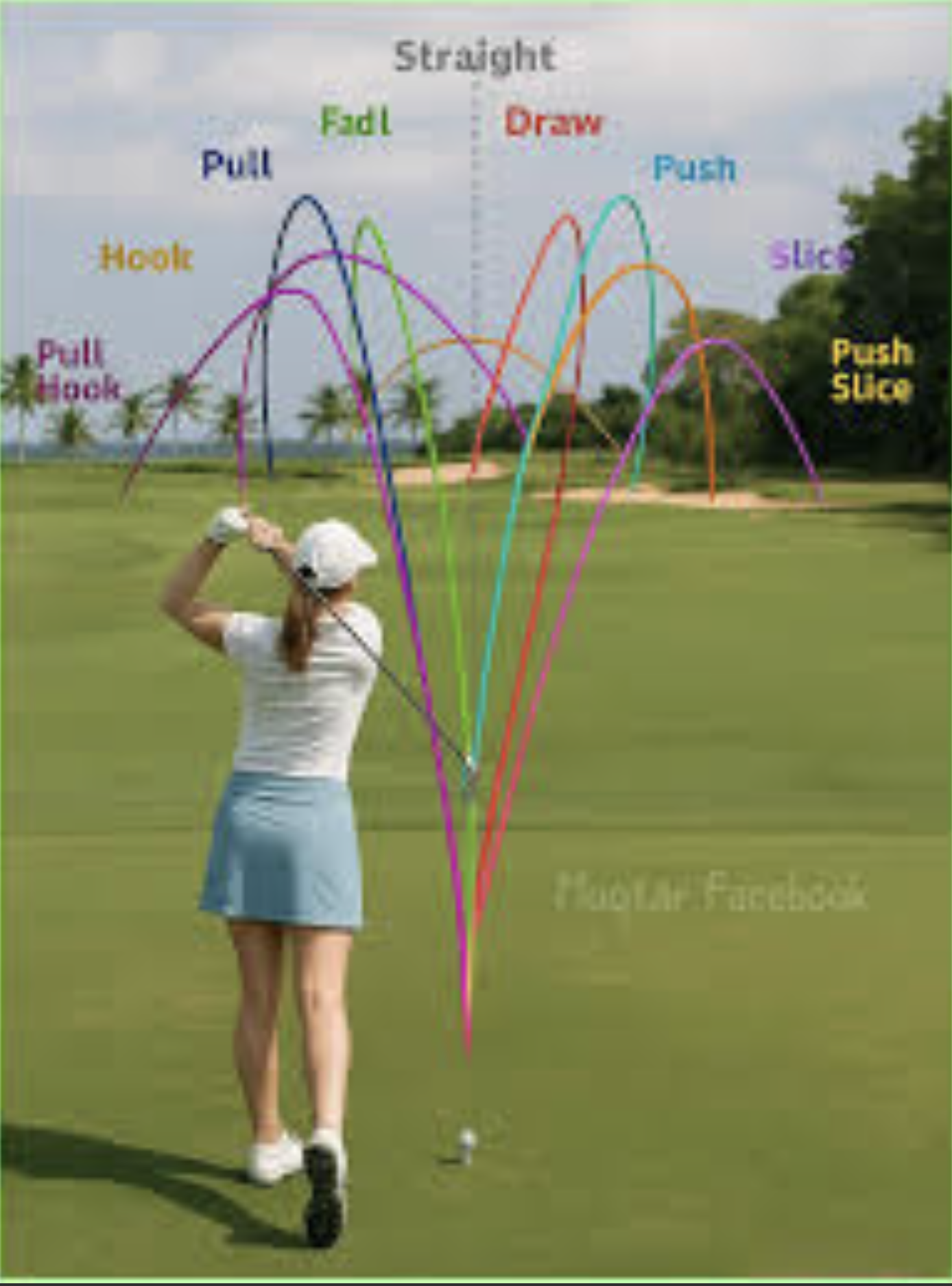
COMMON GOLF SHOTS (The following are made under the assumption that the golfer in question is right-handed:)
Straight: Ball takes straight line to target. (Most difficult shot in golf to execute consistently)
Fade: Ball curves slightly from left to right.
Slice: Larger curve from left to right.
Banana Slice: Even larger curve from left the right.
Draw: Ball moves marginally from right to left.
Hook: more pronounced version of the draw (right to left)
Duck Hook: Greater pronounced version of the hook, usually flies low then Suddenly drops.
Block / Push: The ball flies directly to the right of the target without any curve.
Air-shot: Golfer misses the ball entirely. Sometimes called a ‘fresh air-shot’. Or “swish”
Fat Shot: Occurs when the club head hits the ground first and then the ball. Also known as a ‘heavy’ shot.
Flyer: Occurs when grass gets in between the ball and the club face, reducing spin and therefore increasing distance that the ball is expected to fly (10-20m).
Lob Shot: A slow, rhythmical short distance shot – played with height and often over bunkers. Lands softly with little roll on green.
Pulled Shot: A ball that flies directly left of target – without any curve.
Shank: A Ball that contacts with the hosel and flies off at virtually right angles to the intended flight.
Skied Shot: Happens when the Ball hits the highest part of the clubface, resulting in unusually high trajectory and loss of distance.
Thin Shot: Opposite of a ‘fat’ shot, the thin shot has no divot, shooting off with no backspin.
Topped Shot: Occurs when the club head hits the top of the ball.
Types of Shots
Drive:
The long, powerful shot played from the teeing ground to get the ball as far down the fairway as possible.
Chip:
A short, low-running shot played from a short distance to the green, with the goal of getting the ball rolling to the hole.Putt:
A short, gentle stroke played on the green with a putter to roll the ball into the hole.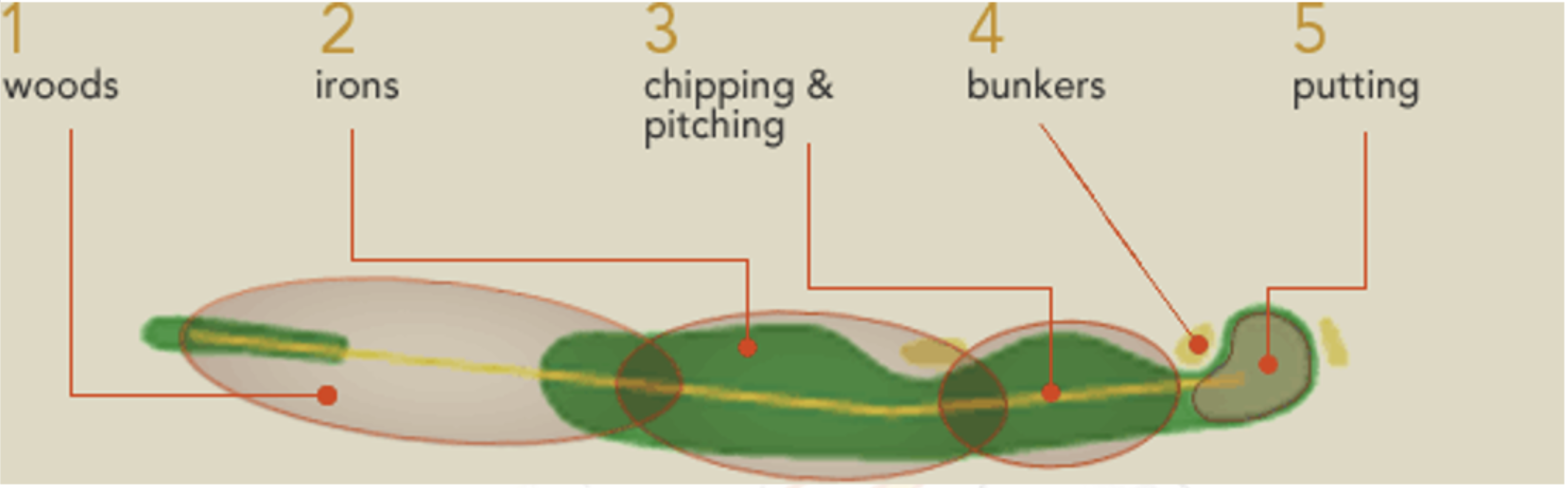
KNOW THE RULES OF GOLF:
Especially Rules of Golf Explained (2023):
Penalty Areas https://www.youtube.com/watch?v=gfjY8G79MEI
Rules: Ball in the water, lost, out of bounds or unplayable
Penalty areas like Water hazards: https://youtu.be/gfjY8G79MEI?si=8kWJC5xwTisChRto
- Water hazard (now known as penalty areas) are defined by yellow stakes or painted lines. Lateral water hazards are identified by red stakes or painted lines.
- You can play the ball inside the hazard if you like or you can:
1. Drop a ball where you played the last shot and add one additional penalty shot.
2. Drop a ball in line with the hole and the place you crossed the hazard and go as far back as you like.
3. If it's a lateral (red staked) hazard you can drop within 2 club lengths of where your ball crossed the line of the hazard. - Very important! You must drop where the ball last crossed a red stake hazard. Many people will cheat and drop in line with where the ball finished. If the water is right in front of the teebox, and that's the last place it crossed, you must drop it on the front of the tee box. You will get chewed out by other players if you drop in the wrong place.
- In a water hazard, sometimes there is no water and you can play out of it.
Lost & out of bounds: https://youtu.be/HEwNzgC9ge4?si=CGePb6BVKen1BjlU
- If you hit a shot and think your ball might be lost in some bushes or similar problem area, or you suspect it could be out of bounds, you can hit a ball from the same position and call it "provisional". Then you can go look for the original ball and if you find it, you can play it and pick up the provisional with no penalty or you can deem the original unplayable and play the provisional ball with a one stroke penalty. You can also deem the ball lost at any stage and just play the provisional with a one stroke penalty.
- You must tell the people you're playing with 'this is a provisional ball'. If you do not, then it is assumed you are using this new ball as your shot and you must add one stroke penalty.
- Definition of lost ball: you can't find it in under 3 minutes or you declare the ball lost. You can also declare a ball lost while you're standing where you hit the bad shot from. Then the next ball you put down in the same spot is the ball in play and you add one penalty stroke.
- Definition of out of bounds: When the entire ball lies outside the white line or stake line signifying the out of bounds border. You must go and hit the ball from the original position if your ball is OB. But there are some places that allow a drop at the point of the out of bounds but with heavy penalty.
Unplayable: https://youtu.be/2KYoSvWx3MI?si=YhpO9414NmQ8OE2M
- If you see your ball and you think you can't play it because it's under a bush or stuck in a tree, you can deem it unplayable, take a penalty shot and:
1. Drop a ball on the line that runs from the hole to where your ball was lying. You can drop as far back as you want on that line.
2. Hit a shot from the same place you hit the last shot.
3. Measure 2 club lengths from where the ball is lying and drop it there.
Final Thoughts
You can take a look at the full rules of golf at the USGA and R&A websites.
Good preparation
Ideally, pack your golf bag the day before and make sure you don’t forget anything. The most important things are:
- Clubs (ideally cleaned)
- Glove
- Balls (take enough and label them with names or signs)
- Tees
- Pitchfork
- Ball marker
- Pen to fill in the scorecard
- Cleaning cloth
- Towel in case of sun
- Umbrella in case of rain
- Rain wear for safety
- Food and drink
Essential Pre-Round Preparation
- Mark your balls: Draw a unique symbol or initials on your golf balls to distinguish them from other players' equipment.
- Count your clubs: Verify you have no more than 14 clubs in your bag to avoid an immediate penalty.
- Pack for conditions: Bring extra tees, a pitchfork, a permanent pen, a towel, and appropriate wet-weather gear.
- Arrive early: Give yourself time to locate the registration desk, check the noticeboard, and use the locker room.
- Check local rules: Read the temporary noticeboard for specific daily rules like "preferred lies" or temporary hazards.
Warming up
Before every game of golf, it is essential to do a rough warm-up; this way you will avoid injuries. To make sure you don’t start out completely cold, practice swings are mandatory. Go to the driving range and hit 2-3 balls with each club.
Then make about 20 approach shots in the pitching area. Finally, make about 20 putts from long and short distances.
The most important thing to remember when practicing: Don’t judge your strokes. Just slowly get a feel for your form on the day and the ball. Under no circumstances should you think that your game will be good or bad because you played well or badly on the driving range. Those are two pairs of shoes. How often do I hear teammates say on the course, “What a stupid thing to say – everything went perfectly on the driving range!”Don’t burn yourself out. You still need a lot of energy for the tournament.
Avoiding stress on the first tee
You’ll be excited – even professionals and old hands get that way. If you accept that and take a deep breath, you’ve already won a lot.
Now for the first shot: Of course, you want to show everyone how well and far you can hit! But the comparison with reality is usually different. 8 out of 10 drives typically fly straight and far for you?
Then, here you go, go for it. - But are the chances more like 50:50? Then you’d better take a club with a hit ratio of at least 80 percent.
Don’t know your odds? This is also part of a game preparation (in general); check on the driving range with 10 shots each, how good all 10 have become. This will help you find your favorite club and also determine which one you need to practice more with.
While you’re at it, make a note of the approximate driving distance of each club.
Additionally, it helps to manifest a stroke routine. You rarely do this as a beginner golfer, but in my opinion, you can’t start early enough. Divide your swing into two phases. In the first phase, take your practice swings (3 at most), then get behind the ball and find a spot where you want the ball to go and visually envision the shot. When you are completely convinced, the second phase begins. Go directly to the ball and make your stroke or swing. During these phases, you are so focused that you probably don’t feel any excitement.
One more important point: sometimes the tournament doesn’t start on tee 1.
Look at the announcement to see if it is a shotgun start. If it is, you will have to start your tournament at the hole that has been noted for you on the scorecard. In the worst case, you will have to allow up to 15 minutes of walking to get there.
Scorecard Duties and Admin
- Exchange cards: You will act as a marker for a playing partner, tracking their score while they track yours.
- Record gross scores: Write down the raw number of strokes taken on each hole; handicap points are calculated later.
- Verify before signing: Check your hole-by-hole scores with your marker immediately after finishing the 18th hole.
- Secure two signatures: Ensure both you and your marker sign your card before handing it in to avoid disqualification
Strategic Mindset and Etiquette
- Play conservatively: Stick to your usual clubs and choose high-control shots over risky, aggressive distance plays.
- Know the rules: Familiarize yourself with basic relief procedures, out-of-bounds rules, and provisional ball protocols.
- Keep the pace: Be ready to hit when it is your turn and walk briskly between shots to keep up with the group ahead.
- Accept bad shots: Tournaments cause extra tension; accept mistakes quickly and reset your focus for the next shot.